

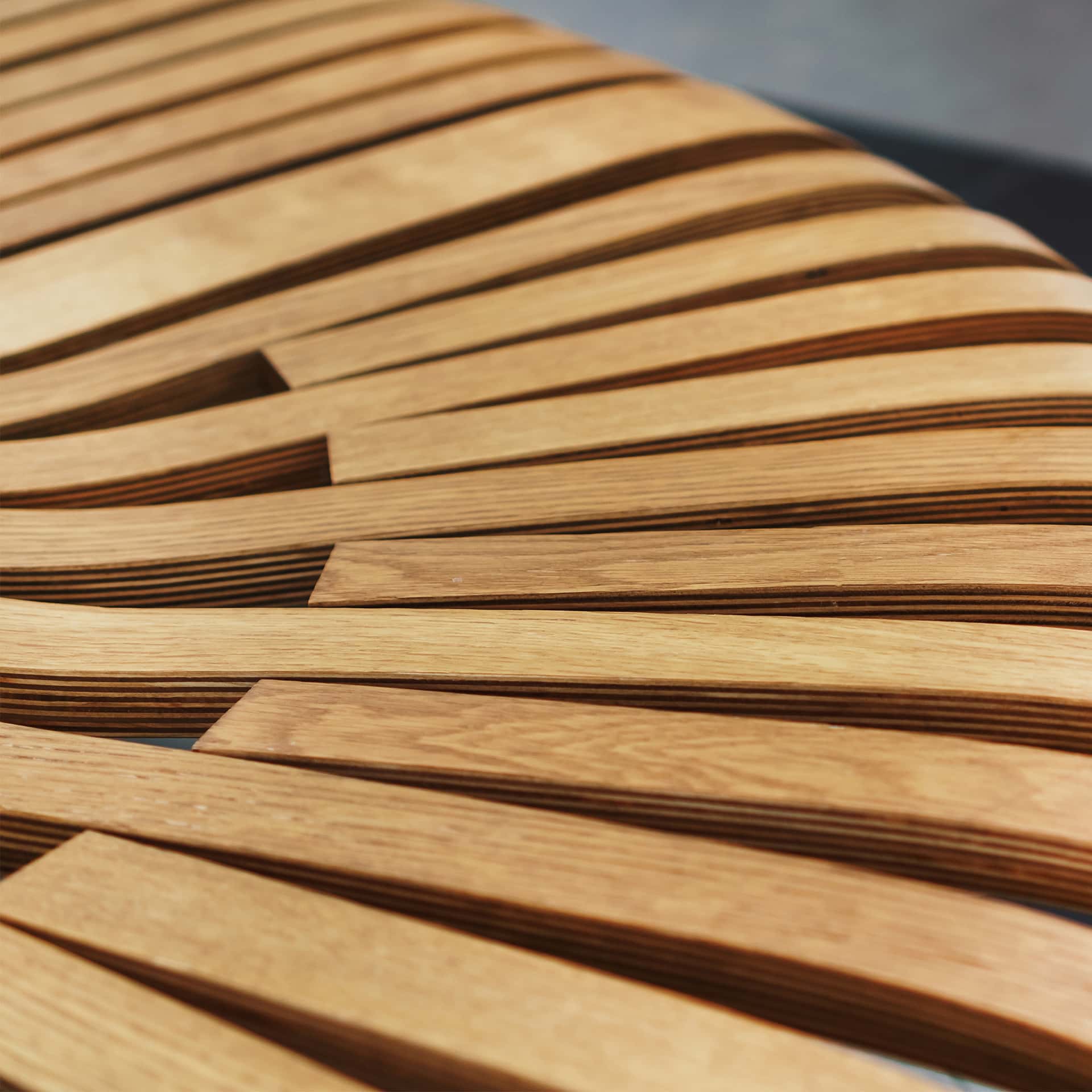
Waterjet cutting wood
Solid wood, MDF, veneer, plywood, fiberboard and more.
Waterjet cutting of wood is a cutting process that offers high precision and quality and is particularly well suited for woodworking. Unlike laser cutting, specific material properties (moisture content, density, oil and resin content) do not need to be taken into account to ensure reliable machining.
A major advantage of waterjet cutting is that the cut is made without the use of heat. The material properties remain unchanged because there is no thermal influence. This keeps the wood material free of dark discoloration on the burr-free cutting edges. This eliminates the need for mechanical finishing in most cases. Even wood species that are normally difficult to cut can be precisely processed with the waterjet.
Another plus point of this process is its environmental friendliness, as no harmful fumes or dusts are produced and the cooling water used can be recycled. This provides a sustainable and resource-saving cutting solution for the wood industry.
Table of Contents
Table of Contents
What types of wood can be cut?
With waterjet cutting of wood, different types of wood can be cut precisely.
Whether cutting softer woods such as balsa or harder woods such as oak and mahogany, the process offers the ability to cut wood up to 300mm thick.
- Solid wood
- MDF
- Veneer
- Plywood
- Fiberboard
- Plywood
- Laminate flooring
- Fiber cement panels
- Chipboard
- Wood composites
Want more information about cutting wood with water?
5 advantages – waterjet cutting wood
Waterjet cutting of wood offers numerous advantages that make it a preferred cutting solution. Thanks to its high precision, the process enables cutting of complex shapes and detailed designs with tight tolerances. At the same time, it preserves the original structure and strength of the wood, as there is no warping or deformation due to heat.
The versatility of waterjet cutting allows it to handle a wide range of wood types and thicknesses, from soft to hard woods, thin plywood sheets to solid wood blocks. In addition, the process is environmentally friendly, as no harmful fumes or dusts are produced and the water used can be recycled.
The material efficiency of the waterjet makes efficient use of wood, resulting in cost savings and more sustainable material use. All these advantages make waterjet cutting an ideal solution for precise and environmentally friendly woodworking.
Technical Details
Several technical aspects are of great importance in waterjet cutting of wood. These include the water pressure and flow rate, which affect the cutting speed and quality, as well as the selection and dosage of the abrasive to ensure the precise machining of different types of wood.
The selection of the right nozzle shape and size is crucial for the jet angle and the precision of the cutting process. Precise CNC control ensures the exact implementation of the desired cutting pattern, while the optimum distance between the nozzle and the workpiece is important for an efficient cutting process. In addition, an efficient water purification system enables the sustainable reuse of water and contributes to the environmental friendliness of the process.
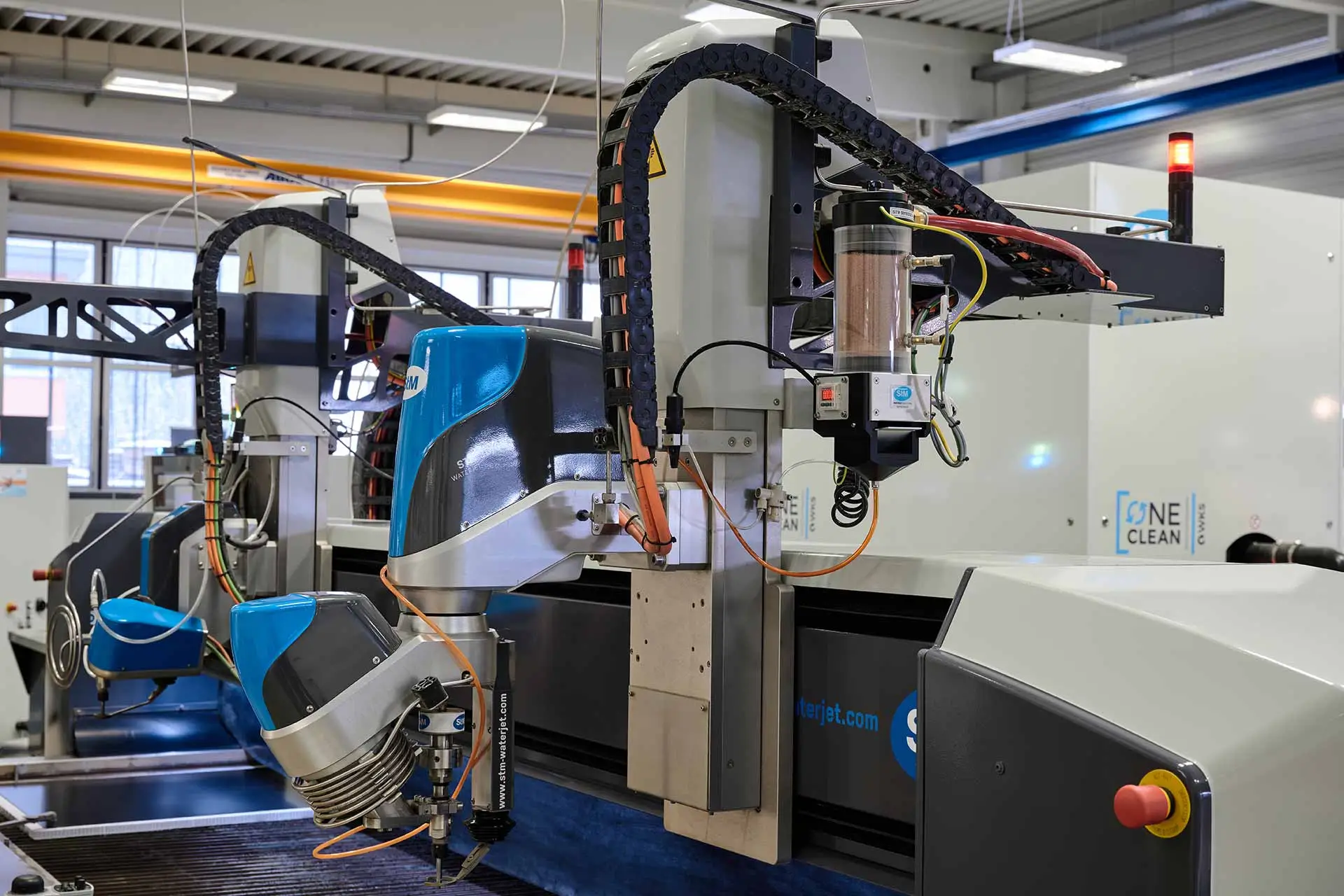
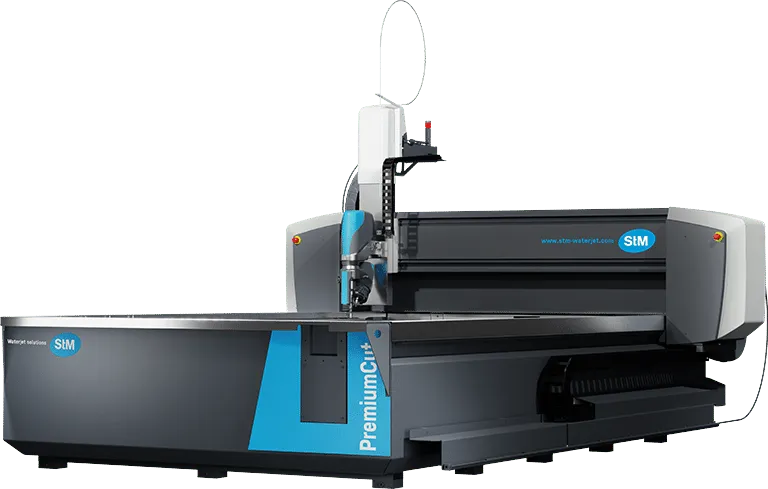
Modern waterjet cutting systems from STM offer a wide range of fine-tuning options and guarantee the highest precision and quality when cutting wood.
For thinner wood species such as balsa or plywood, precise cuts can be made in thicknesses of approximately 1 mm – 10 mm. For thicker species such as solid wood or some hardwoods, cuts up to a thickness of 250 mm or more may be possible.
Any type of cut and bevels up to 60° are possible.
Cutting accuracy is typically +/- 0.1 mm.
In waterjet cutting, cut quality is generally classified into 5 quality levels.
- Separating cut Q1 (for blanks / semi-finished products) Tolerance range 0.3 mm
- Standard cut Q3 (the most common cut) Tolerance range 0.2 mm
- Fine cut Q5 (for optimum dimensional accuracy) Tolerance range 0.1 mm
In waterjet cutting of wood, the achievable cutting speeds are usually in the range of 600 to 3000 mm per minute.
As a rule, the water pressure for glass processing is between 2000 and 4000 bar.
A CNC control system enables precise and repeatable cutting. The STM SmartCut cutting software offers ease of use, functionality, and flexibility.
References
As we all know, satisfied customers are the best form of advertising
In our references section, you’ll find clients and partners from a wide variety of industries. These include businesses and organizations from the following industries:
- Metal Industry
- Stone / Ceramics / Glass
- Plastics and Foam Industry
- Sealing Industry
- Prototype and Plant Engineering
- Micro-water jet
- Educational institutions
- Research
- Special Materials
STM Product Finder
Find the Work System That’s Right for You
Our customers’ individual wishes and requirements are our top priority. To offer customized solutions for every need, we have developed a special product finder.
You tell us what you need to deliver perfect results, and we’ll put together the individual components and parts—as well as the corresponding software—to create a perfect, customized solution. And if you’re unsure, try out your materials with our test cut.
FAQ – Frequently Asked Questions
The most frequently asked questions about waterjet cutting of wood
We’ve compiled a list of frequently asked questions (FAQs) on waterjet cutting of wood and provided concise answers for you.
If you can’t find the answer to your question, please feel free to contact us directly.
Is waterjet cutting suitable for all types of wood?
Waterjet cutting is suitable for a wide range of wood species,from soft to hard woods, and allows precise cuts without deformation or warping.
Up to what material thickness can wood be cut with a waterjet?
Waterjet cutting can precisely cut wood materials with a thickness of a few millimeters up to 250mm or more.
Is waterjet cutting of wood environmentally friendly?
a, waterjet cutting is environmentally friendly as it produces no harmful fumes or dust and the water used can be recycled.
What are the advantages of waterjet cutting for wood?
Waterjet cutting offers many advantages such as high precision, no thermal influence, versatility, material efficiency and environmentally friendly properties for woodworking.
Can waterjet cutting cut wood in complex shapes?
Yes, thanks to the precise CNC control, complex shapes and detailed designs can be cut from wood materials.
Is waterjet cutting of wood cost effective?
Waterjet cutting can be a cost-effective cutting solution due to the material efficiency and fast processing of wood materials.
Does the water jet achieve different results with each type of wood?
The quality of the waterjet cutting process depends on the quality of the wood. The wood must be able to withstand the pressure of the water jet. Hard knots with grain may affect the result.
Does the waterjet cutting process affect the shape of the wood?
If used correctly, there is no risk of damaging your wooden parts. The high precision results in smooth wood edges which do not need to be reworked.
Is waterjet cutting of wood better than sawing wood?
Sawing is a time-consuming process and can generate dust. Waterjet cutting of wood is fast and produces no dust or other debris.